The Hidden Meaning Behind Kimono Outfits in Anime and Manga
In anime and manga, clothing isn’t just about aesthetics — it’s a form of language.
Every fold of silk, every brushstroke of pattern carries centuries of meaning.
And when it comes to the kimono, that meaning runs especially deep.
The kimono, long a symbol of elegance, hierarchy, and seasonality in Japan, has become a storytelling tool in modern animation.
Through its colors and motifs, anime artists reveal who a character truly is — not just how they look, but how they feel.
???? 1. The Kimono as Emotional Symbolism
A kimono moves like emotion.
Its flowing sleeves mirror hesitation; its layered fabric conceals vulnerability.
In traditional Japanese theatre (Noh and Kabuki), the color and motion of garments were carefully chosen to express states of mind.
Modern anime inherited that discipline.
When a character wears a kimono, it’s rarely random.
The design communicates values — purity, courage, melancholy, transformation — even before a single word is spoken.
???? 2. Demon Slayer: Patterns That Speak
Perhaps no series captures this better than Demon Slayer: Kimetsu no Yaiba.
Every protagonist wears a haori or kimono that acts as a mirror of their soul.
Tanjiro’s checkered green-and-black pattern, known as ichimatsu, symbolizes the eternal balance between life and death — the perfect metaphor for a boy who lives between the worlds of humans and demons.
Nezuko’s pink kimono, adorned with a hemp-leaf motif (asanoha), represents growth, protection, and resilience — a quiet reminder of her purity despite her transformation.
Rengoku’s flame-patterned robes embody devotion and passion, burning bright even in tragedy.
And Shinobu Kocho’s butterfly sleeves — graceful yet lethal — visualize compassion wrapped around vengeance.
These aren’t just artistic flourishes.
They are extensions of identity — a visual poetry that tells the viewer who these characters are and what they carry.
???? 3. Spirited Away: The Kimono as Transformation
Studio Ghibli’s Spirited Away uses the kimono as a symbol of growing up.
When Chihiro arrives in the spirit world, her dull everyday clothes mark her as a child.
But once she dons a simple pink work kimono at the bathhouse, her silhouette softens — she looks more humble, more in tune with the world around her.
That change of clothing signifies her emotional maturity.
As the film unfolds, her kimono becomes dirtied, wrinkled, lived-in — just like her journey.
The garment grows with her, turning a uniform into a metaphor for courage and adaptation.
???? 4. Jujutsu Kaisen and Bleach: Power Through Tradition
Even in modern-action anime, kimono aesthetics persist.
In Jujutsu Kaisen, Gojo Satoru’s layered uniforms draw subtle inspiration from haori and hakama silhouettes — modern reinterpretations of spiritual armor.
In Bleach, captains wear flowing white coats modeled after priestly robes, echoing the Shinto ideal of purification before battle.
This visual continuity — old forms reborn in new contexts — allows the kimono to stay timeless.
It’s tradition, reimagined through movement and power.
???? 5. Naruto: The Cloak of Legacy
Even Naruto, a series grounded in ninja mythology, carries echoes of the kimono’s symbolism.
The robes worn by Hokage and clan elders are styled after ceremonial uchikake, their sweeping hems symbolizing authority and generational continuity.
When Naruto finally dons his orange-and-white cloak, it’s not just a costume upgrade — it’s a rite of passage.
He has inherited a legacy as heavy and beautiful as the garment itself.
???? 6. The Language of Color and Pattern
In Japanese visual culture, colors are moral and emotional codes.
White evokes purity or death; red means vitality and divine protection; purple signals nobility; blue suggests calm and introspection.
When anime artists paint these hues onto kimono fabric, they’re drawing from over a thousand years of symbolism.
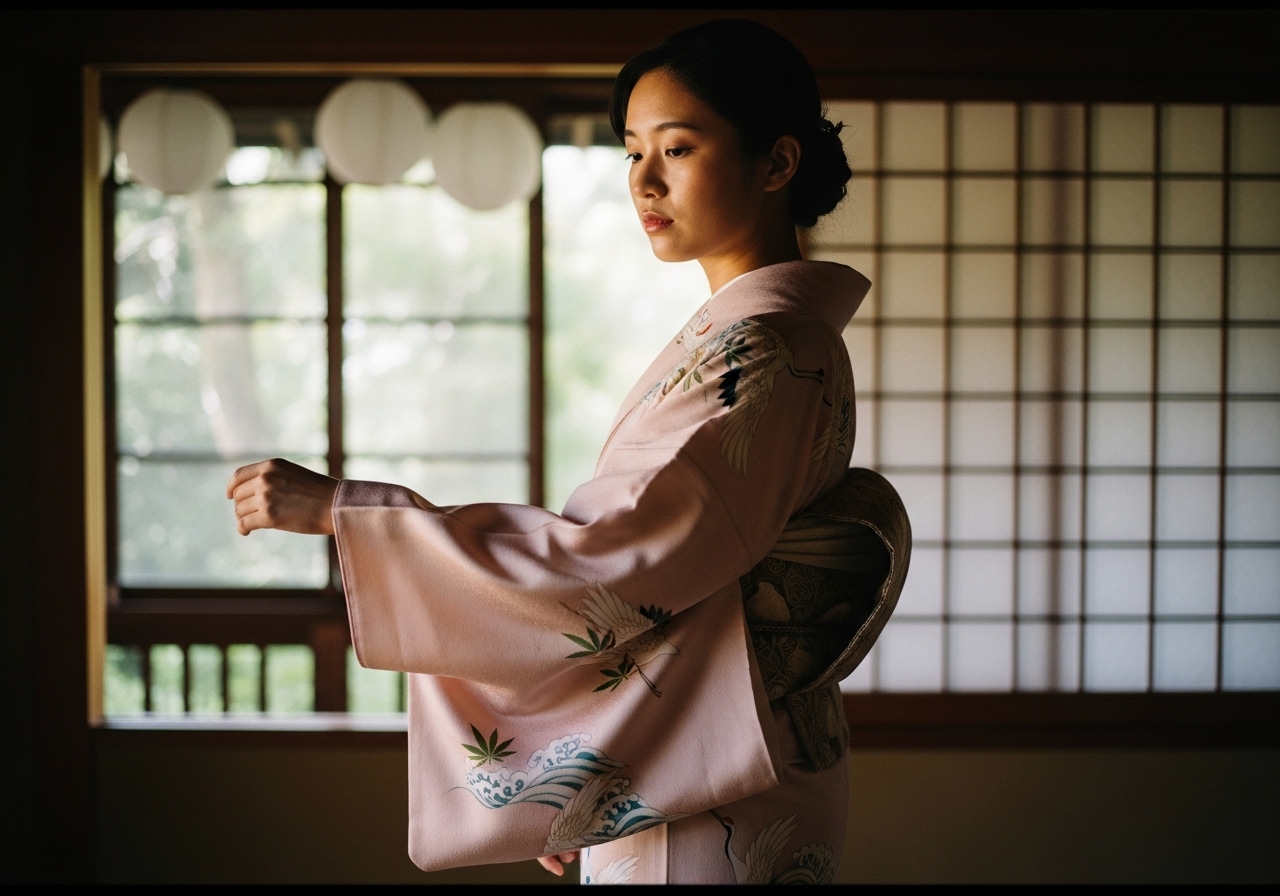
Patterns do the same: waves for resilience, cranes for longevity, plum blossoms for hope amid hardship.
A single sleeve can carry the emotional weight of an entire narrative.
???? 7. A Global Symbol Reimagined
Today, anime fans across the world wear kimono-inspired fashion — from casual haori jackets to full traditional attire at conventions.
But beyond the trend lies something deeper: a shared fascination with the storytelling hidden in cloth.
Designers from Paris to São Paulo now study these visual codes, seeing how simplicity and symbolism can coexist.
It’s proof that the kimono isn’t static; it adapts, speaks, and travels — just like the stories it lives within.
????️ 8. The Heart Beneath the Fabric
In the end, anime doesn’t just show the kimono — it restores its voice.
It reminds global audiences that beauty can hold philosophy, that patterns can tell truths words cannot.
Every character’s garment becomes a chapter in a much older tale — one that began in Kyoto’s looms and continues through glowing screens worldwide.
The next time you see an anime hero with flowing sleeves or intricate patterns, look closer.
The fabric is whispering something ancient, something human —
a message of identity, resilience, and the quiet strength that comes from wearing one’s story.





 BOOK NOW