Haori and Hakama | The Formal Combination Behind Japan’s Traditional Menswear
In Japan, formal menswear is more than just a suit and tie. It’s a visual language of respect, status, and precision that has evolved over centuries. At the heart of that language lies one timeless pairing — the haori and hakama.
This combination, seen at weddings, tea ceremonies, and graduations, is not simply traditional clothing. It is the Japanese equivalent of black-tie attire: refined, symbolic, and deeply connected to family and ceremony.
If you’ve already read our guides on “What Is a Hakama?” and “Hakama vs Kimono,” you’re ready to understand how the haori completes the ensemble — and why this pairing continues to define Japanese formalwear today.
What Are the Haori and Hakama?
The haori is a hip- or thigh-length jacket worn over a kimono. Originally a samurai’s outer coat, it evolved into a formal jacket that adds both warmth and elegance. The hakama, meanwhile, is a pleated over-garment worn over the kimono, resembling wide trousers or a long skirt.
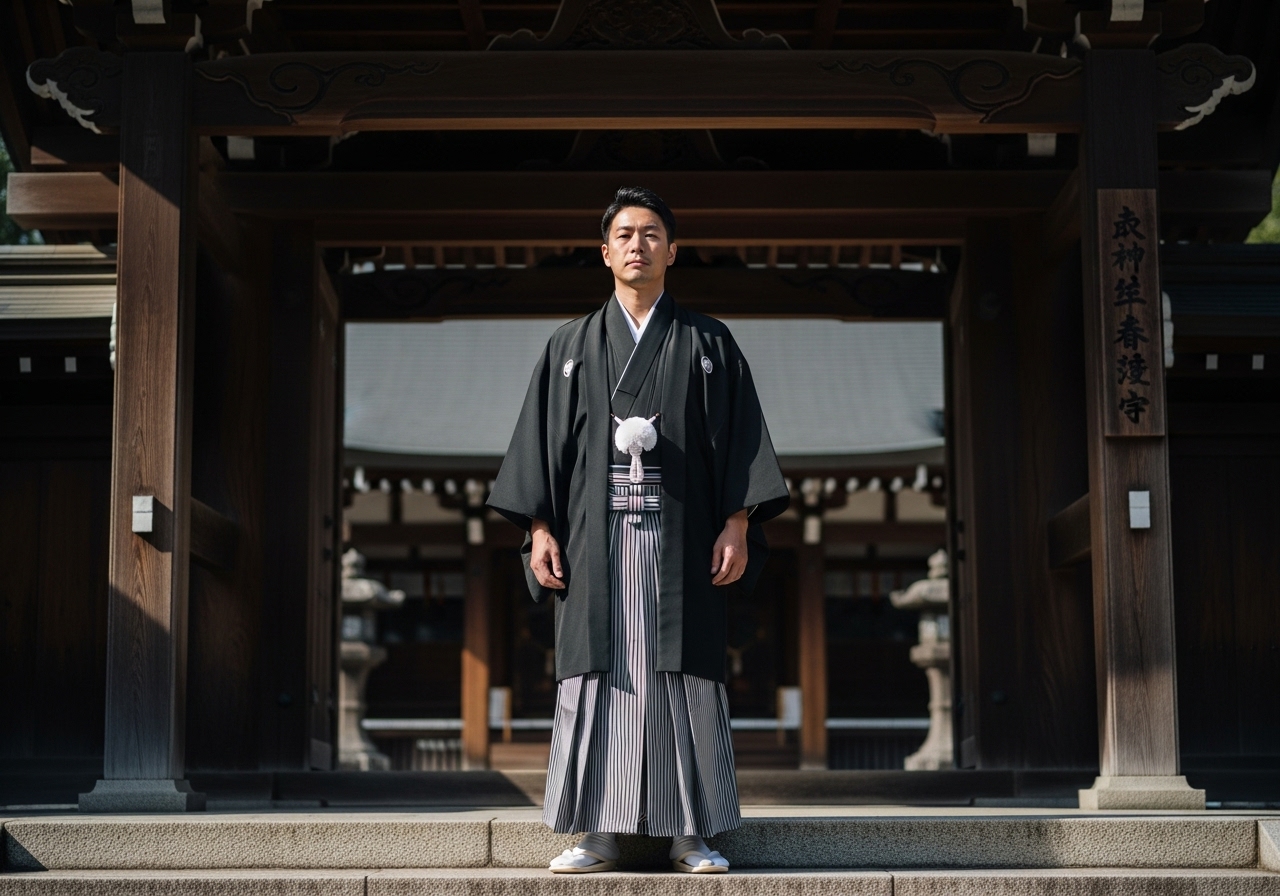
Together, they create the haori-hakama set, Japan’s most formal men’s attire, often worn with a montsuki kimono — a black silk kimono decorated with the wearer’s family crests (kamon).
This trio — haori, montsuki kimono, and hakama — forms the montsuki haori hakama, the pinnacle of male ceremonial dress in Japan.
The History Behind the Combination
The pairing of haori and hakama dates back to the Edo period (1603–1868). Samurai wore haori over their armor to protect against the cold and to signify rank. Over time, as peace replaced warfare, this outfit became a symbol of dignity rather than combat.
By the Meiji era (1868–1912), the haori-hakama set had become standard formalwear for educated men, officials, and nobles. Even as Western suits gained popularity, this traditional style endured for events that demanded solemnity — a wedding, a graduation, a tea ceremony, or an imperial audience.
To this day, when a man wears haori and hakama, he signals not nostalgia but respect — for formality, heritage, and the people he stands before.
The Montsuki: Japan’s Black-Tie Equivalent
At the highest level of formality, men wear a black montsuki kimono under the haori and hakama. The montsuki bears five family crests — one on the back, one on each chest, and one on each sleeve.
When paired with gray-and-white striped hakama and a black haori, it becomes Japan’s equivalent of a tuxedo or morning coat. Every element carries meaning:
Black symbolizes purity, humility, and respect.
The crests identify the wearer’s family and lineage.
The stripes on the hakama signify balance and stability.
The full montsuki haori hakama ensemble is traditionally worn at weddings, funerals, and New Year’s ceremonies — the most significant milestones in life.
How It’s Worn
Dressing in haori and hakama requires precision. The kimono is worn first, left collar over right. Then the hakama is tied around the waist, its pleats arranged carefully to fall straight. Finally, the haori is draped over the shoulders and fastened in front with a decorative braided cord known as the haori-himo.
The result is a silhouette that is structured yet fluid — straight lines, broad stance, and subtle movement. The outfit transforms posture and presence, creating a quiet authority that modern suits rarely achieve.
Occasions for Wearing Haori and Hakama
This attire appears in several key moments of Japanese life:
Weddings: The groom, and sometimes the fathers of both families, wear montsuki haori hakama to signify respect and unity.
Graduations: Male students and professors may wear subdued versions, symbolizing academic achievement and tradition.
Tea ceremonies: Masters and guests don haori-hakama for major gatherings, emphasizing humility and discipline.
Shinto rituals: Priests and shrine attendants may wear ceremonial versions in white or colored silk.
Even outside Japan, martial arts masters often wear haori and hakama at demonstrations or ceremonies, preserving the sense of dignity tied to their heritage.
Modern Interpretations
While few Japanese men own haori and hakama today, they remain available through kimono rental services for formal occasions. Many couples choose traditional attire for their weddings, combining Western and Japanese elements — the groom in montsuki haori hakama, the bride in a white shiromuku.
Contemporary designers have also reimagined the haori as a casual jacket, blending traditional tailoring with modern fabrics. You’ll find haori-style coats in Tokyo boutiques and even international fashion houses — proof that this centuries-old garment continues to evolve.
Why the Combination Endures
The power of the haori and hakama lies in restraint. Unlike Western formalwear that relies on accessories or shine, Japanese formality comes from balance and discipline. Every fold and knot carries intention.
To wear this outfit correctly is to express rei — respect. Not only for tradition, but for the people sharing the moment. It’s an unspoken way of saying, “This occasion matters.”
That sense of mindfulness is what makes the haori and hakama so enduring. They’re not relics of the past — they’re living symbols of composure and grace.
Final Thoughts
The haori and hakama represent more than elegance — they embody the philosophy of Japanese formalwear: modest, measured, and meaningful. From samurai origins to modern ceremonies, this timeless ensemble continues to bridge past and present.
Whether you see it at a Kyoto wedding, a Tokyo graduation, or a martial arts demonstration abroad, the haori-hakama set reminds us that true sophistication is never loud — it’s found in quiet confidence, precision, and respect.






 BOOK NOW