What Is a Montsuki Kimono? A Deep Look into Japan’s Most Formal Traditional Wear for Men
Among all the garments in Japan’s long clothing tradition, the montsuki kimono is one of the most understated and, at the same time, one of the most powerful. It does not rely on bright colors or flashy patterns. Instead, the montsuki kimono speaks in black silk, clean lines, and five small family crests. For Japanese men, this is the outfit you choose when the occasion truly matters.
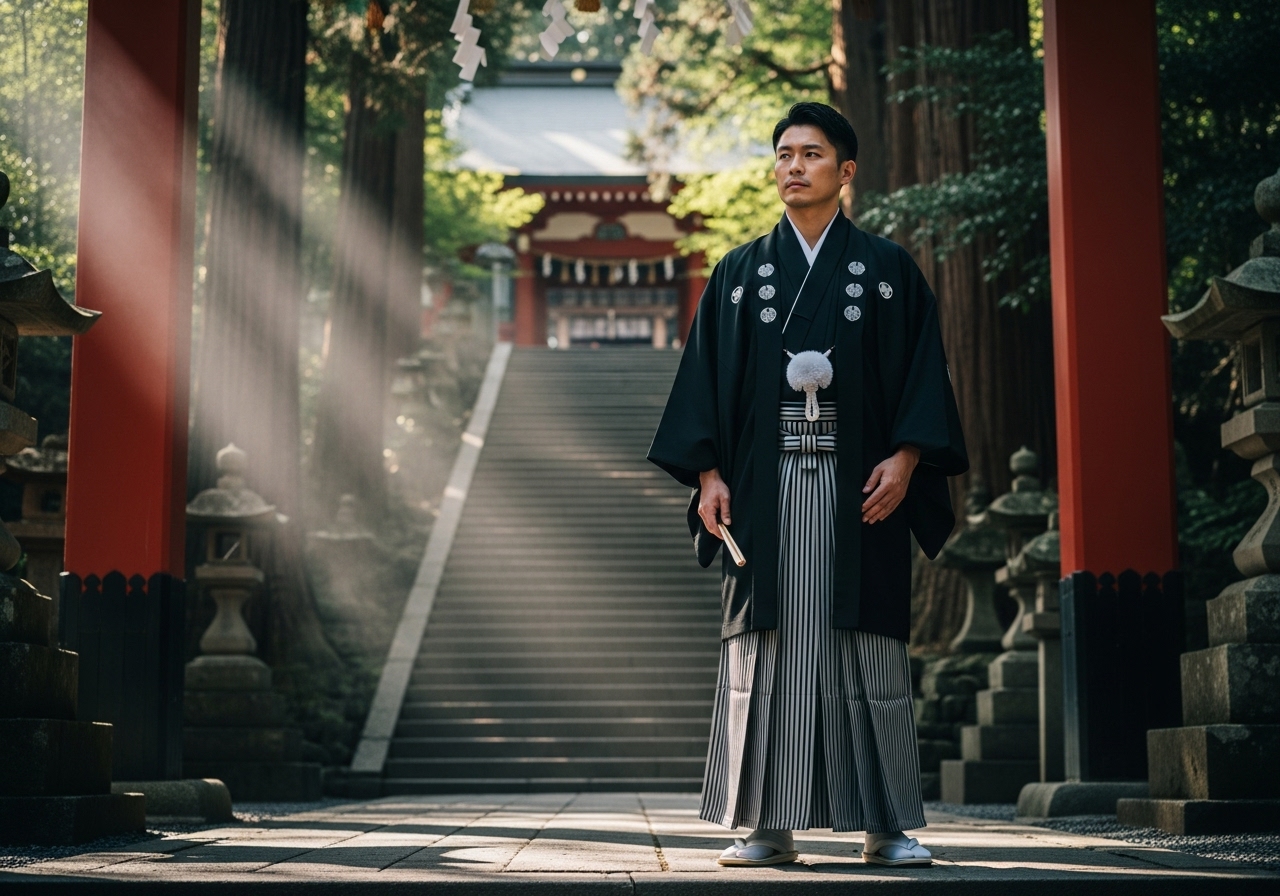
At its simplest, “montsuki” means “with crests.” A montsuki kimono is a formal kimono that bears the wearer’s family crests, called kamon, printed or embroidered in white. They are usually placed on the back, the chest, and the sleeves. The most formal version is the kuro montsuki, an all-black silk kimono decorated with five crests and worn with striped hakama trousers and a haori jacket. For more than a century, this full set has been regarded as the highest level of male formal wear in Japan, the traditional equivalent of a tuxedo or morning coat.
Historically, the roots of the montsuki kimono go back to the Edo period, when strict rules governed who could wear what. Samurai families wore crest-bearing garments to signal status, loyalty, and household identity. Over time, the style spread beyond warriors to wealthy townsmen and eventually to the wider public for formal occasions. The black montsuki, in particular, became standard when men needed to show deep respect, whether in the presence of a lord, during rituals, or at important family events. Even now, when Western suits dominate everyday life, montsuki still appears at moments that call for ceremony and tradition.
Visually, the montsuki kimono is defined by its restraint. The base is usually a deep, matte black, sometimes with a subtle woven pattern you only notice up close. The family crests are small circles of white, sharply contrasting against the black, arranged in a precise pattern: one on the upper back, one on each sleeve, and one on each side of the chest. There are also versions with three or one crest, used for slightly less formal situations, but five crests signal the highest level of formality.
The kimono is almost always worn with a white under-kimono, a narrow formal obi, and striped hakama in shades of black and gray. The haori jacket, also crested, completes the look. White tabi socks and formal zori sandals finish the ensemble. There is nothing flamboyant about it, yet when a man walks into a room dressed in kuro montsuki haori hakama, he looks completely ready for the occasion—whether it is a wedding, a tea ceremony, or a graduation.
The occasions where montsuki is worn tell you a lot about its role in Japanese life. At traditional weddings, the groom often wears a black montsuki kimono with hakama, while the fathers of the bride and groom may also choose the same outfit to show solidarity and respect. At funerals, a variation of montsuki may be worn in combination with black accessories, the crests signaling family identity even in mourning. Coming-of-age ceremonies, formal New Year’s visits, and some tea ceremony gatherings may also call for montsuki, especially for men who want to follow classical etiquette. In martial arts such as iaidō or kyūdō, instructors sometimes wear montsuki and hakama during demonstrations or examinations to underline the dignity of the event.
Compared to women’s formal kimono, which rely on color and pattern, the montsuki kimono expresses formality through structure and silence. It uses very few visual elements: one color, one type of fabric, a handful of small motifs. That is precisely why each detail matters. The quality of the silk, the crispness of the pressing, the placement of the crests, the way the hakama lines fall—all of this is read, consciously or not, by those who see it. A well-worn montsuki does not draw attention to itself, but it does command quiet respect.
Learning to wear a montsuki correctly is an art in itself. First, the inner kimono must be put on and adjusted so that the collars overlap neatly, left over right, and the hem falls at the proper length. The formal obi is tied firmly around the waist. Then the striped hakama is wrapped and knotted, its pleats aligned so they fall straight down the legs. The montsuki kimono and haori jacket must sit smoothly over all of this, with the crests properly centered and visible. Finally, the haori-himo, the braided cord at the front of the jacket, is tied in a specific knot. For someone new to kimono, this is not something you improvise; most people rely on professional dressers for important occasions.
There are also variations within the category of montsuki kimono. Not all montsuki are black; colored versions, known as iro-montsuki, may appear in dark navy, brown, or green with crests. These still count as formal, but are a step down from the absolute peak represented by the black five-crest set. The number of crests itself signals the formality level: five for the most formal, three for mid-level, and one for semi-formal use. This coding allows men to adjust their outfit precisely to the time, place, and occasion—a key concept in Japanese etiquette.
In modern Japan, most men do not own a montsuki kimono for daily life. Suits are more practical, and kimono in general have become special-occasion clothing. However, many families either keep an heirloom montsuki or rent one when necessary. Kimono rental shops across Japan offer montsuki sets for grooms and guests, complete with dressing services and accessories. For foreign visitors interested in traditional clothing, renting a montsuki can be an eye-opening experience. The weight of the hakama, the feel of the silk against the skin, and the restricted but graceful movement all give a different sense of posture and presence compared to Western clothes.
Owning a montsuki kimono is a commitment. Because the garment is so closely tied to family identity, the choice of crests matters. Traditionally, a man would use his family’s inherited kamon, and a tailor would position them according to strict rules. The kimono must be cleaned and stored carefully, ideally folded in a special paper and kept in a dry, dark place. Many people treat a montsuki the way they might treat a good suit or even an heirloom watch: something you take out only at the right moment, but expect to last for decades.
What makes the montsuki kimono fascinating is that it occupies two spaces at once. On one hand, it is completely practical—it is an outfit for specific formal events, governed by clear conventions. On the other hand, it carries a quiet emotional weight. To see someone in montsuki is to understand that the moment is important, that families and history are involved, that something is being honored.
In a world where clothing is often loud, trend-driven, and disposable, the montsuki kimono stands for something else. It suggests that elegance can be simple, that respect can be shown through discipline, and that identity can be expressed with just a few white circles on black silk. If you ever come across a ceremony in Japan where men appear in this outfit, it is worth pausing for a moment. You are not just looking at formalwear; you are seeing centuries of etiquette and aesthetics distilled into a single, quietly powerful garment.





 BOOK NOW