FROM THE BATTLEFIELD TO THE RUNWAY: THE ARCHITECTURAL EVOLUTION OF THE HAORI JACKET
While the kimono is the soul of Japanese dress, the Haori jacket is undoubtedly its most versatile and stylish companion. To the casual observer, it may look like a simple overcoat, but the Haori carries a history of rebellion, status, and hidden luxury that sets it apart from any other garment in the world. For the sophisticated traveler visiting Osaka in 2026, understanding the lineage of the Haori allows for a much richer styling experience, moving beyond the traditional and into the realm of high-fashion curation.
THE SAMURAI ORIGINS: THE JINBAORI
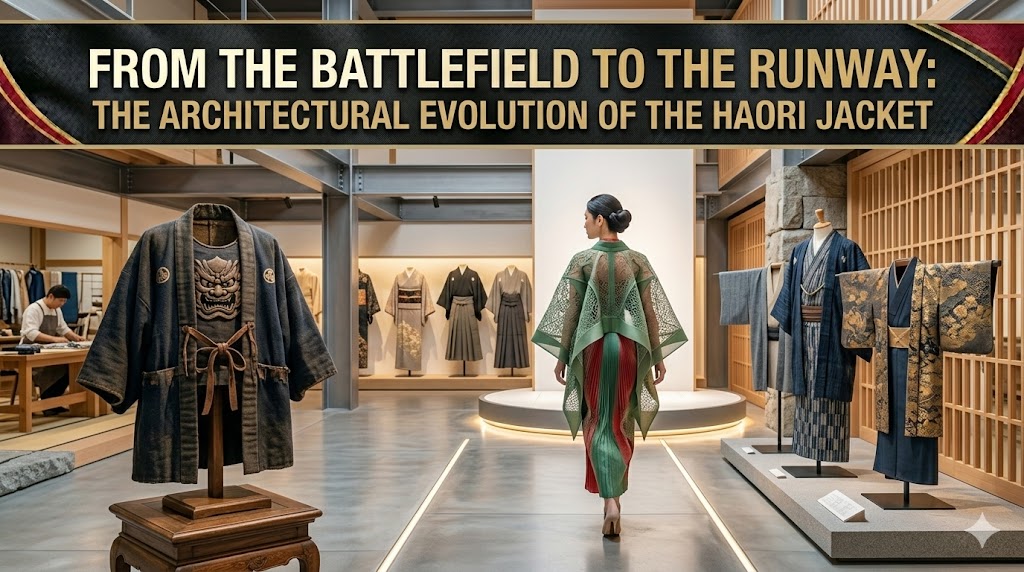
The ancestor of the modern Haori was born in the chaos of the Sengoku (Warring States) period. Known as the Jinbaori, or camp vest, it was a sleeveless outer garment worn by high-ranking samurai over their armor. Its purpose was twofold: to provide protection against the elements and to serve as a bold visual signal on the battlefield. These early jackets were often made from heavy, expensive materials like wool or imported Chinese silks, frequently featuring massive family crests on the back. When you wear a Haori today, you are carrying the DNA of a garment once reserved for the military elite.
THE EDO PERIOD AND THE ART OF HIDDEN LUXURY (URA-MASARU)
During the peaceful Edo period, the Haori transitioned into civilian life, becoming a staple for wealthy merchants. However, this era was marked by strict sumptuary laws—government regulations that forbade commoners from wearing flashy or overly expensive clothing. This gave rise to one of the most unique aspects of Japanese aesthetics: Ura-masaru, or hidden beauty.
To avoid the eyes of the law, merchants would wear Haori made of plain, dark silk on the outside. But on the inside, the lining was a canvas for incredible artistry. These hidden linings featured intricate hand-painted landscapes, erotic scenes, or legendary heroes. The philosophy was simple: true luxury is for the wearer to know, not for the world to see. Even today, a high-quality vintage Haori is often judged by the beauty of its silk lining rather than its exterior color. For the modern wearer, this adds an element of "secret fashion" that feels incredibly sophisticated and personal.
THE GENDER REVOLUTION IN THE MEIJI ERA
It is a little-known fact that for centuries, the Haori was a strictly masculine garment. It was not until the late 19th century, during the Meiji era, that women began to adopt the Haori into their wardrobe. It started with the geiko (geisha) of the entertainment districts, who wore them as a fashion statement to display an air of independence and strength. Eventually, the trend spread to the general public. This shift transformed the Haori from a rigid symbol of status into a fluid, artistic accessory that could be used to balance the proportions of a kimono silhouette.
THE HAORI-HIMO: THE JEWELRY OF THE JACKET
Unlike a kimono, which is secured by an obi belt, the Haori is never fully closed. It is held together by the Haori-himo—delicate, hand-braided silk cords that connect at the chest. In 2026, these cords have become a focal point for modern styling. High-end Haori-himo often feature semi-precious stones, magnetic clasps, or intricate knotting techniques like the "Koma-musubi." Choosing the right cord is the final touch of a curated outfit, functioning like a piece of high-end jewelry that anchors the entire look.
MODERN VERSATILITY: THE GLOBAL STREETWEAR ICON
Today, the Haori has transcended the boundaries of traditional Japanese culture to become a staple of global high-fashion. Designers in Paris, New York, and Milan have all looked to the T-shaped silhouette for inspiration. For the visitor in Osaka, the vintage Haori is the ultimate souvenir because of its extreme versatility.
Unlike a full kimono, which requires professional assistance to wear correctly, a Haori can be thrown over a simple T-shirt and jeans or a sleek evening dress. It provides an instant architectural structure to any outfit. The Oshima Tsumugi silk Haori, in particular, is prized for its lightweight, windproof qualities and subtle sheen, making it the perfect luxury travel layer.
CONCLUSION: WEARING HISTORY WITH CONFIDENCE
When you choose a Haori to complete your look, you are not just adding a layer for warmth. You are participating in a tradition of hidden luxury and warrior heritage. Whether you prefer a bold, vintage print from the Showa era or a minimalist silk piece that whispers of Edo-period sophistication, the Haori allows you to navigate the modern streets of Osaka with the quiet confidence of a samurai and the refined eye of a merchant. It is the bridge between the ancient world and the global future.






 BOOK NOW