The Evolution of Elegance: A Journey Through Kimono History
The word “Kimono” originally meant simply “something to wear,” but today it represents one of the most iconic symbols of Japanese culture. Although the silhouette we recognize took shape centuries ago, the kimono has continuously evolved alongside Japan’s history.
Let us walk through time and explore how this garment became a symbol of refined beauty.
――――――――――
Nara period: The Two-Piece Era
During the Nara period (710–794), Japanese clothing was heavily influenced by continental Asia, particularly China. At this time, garments were not yet the single-robe structure we associate with kimono today.
People typically wore:
Separate upper garments
Trousers or skirts as lower garments
Functionality was prioritized. Clothing allowed ease of movement and reflected structured court culture influenced by the Tang dynasty. The idea of wrapping the body in one continuous robe had not yet fully developed.
――――――――――
Heian period: The Birth of the Straight-Line Cut
The Heian period (794–1185) marked a turning point. The innovation of “Chokusen-dachi,” or straight-line cutting, revolutionized clothing construction.
Instead of tailoring garments to fit body curves, fabric was cut in straight lines and sewn together. This approach created:
A flexible, adjustable silhouette
Garments that fit different body types
Efficient use of expensive silk
Adaptability
Layering became essential. In winter, multiple layers provided warmth. In summer, lightweight materials such as linen offered breathability.
Color Harmony
As layering increased, aristocrats developed sophisticated color combinations reflecting the seasons—plum for early spring, maple for autumn, and so on. Clothing became poetic expression.
Did you know?
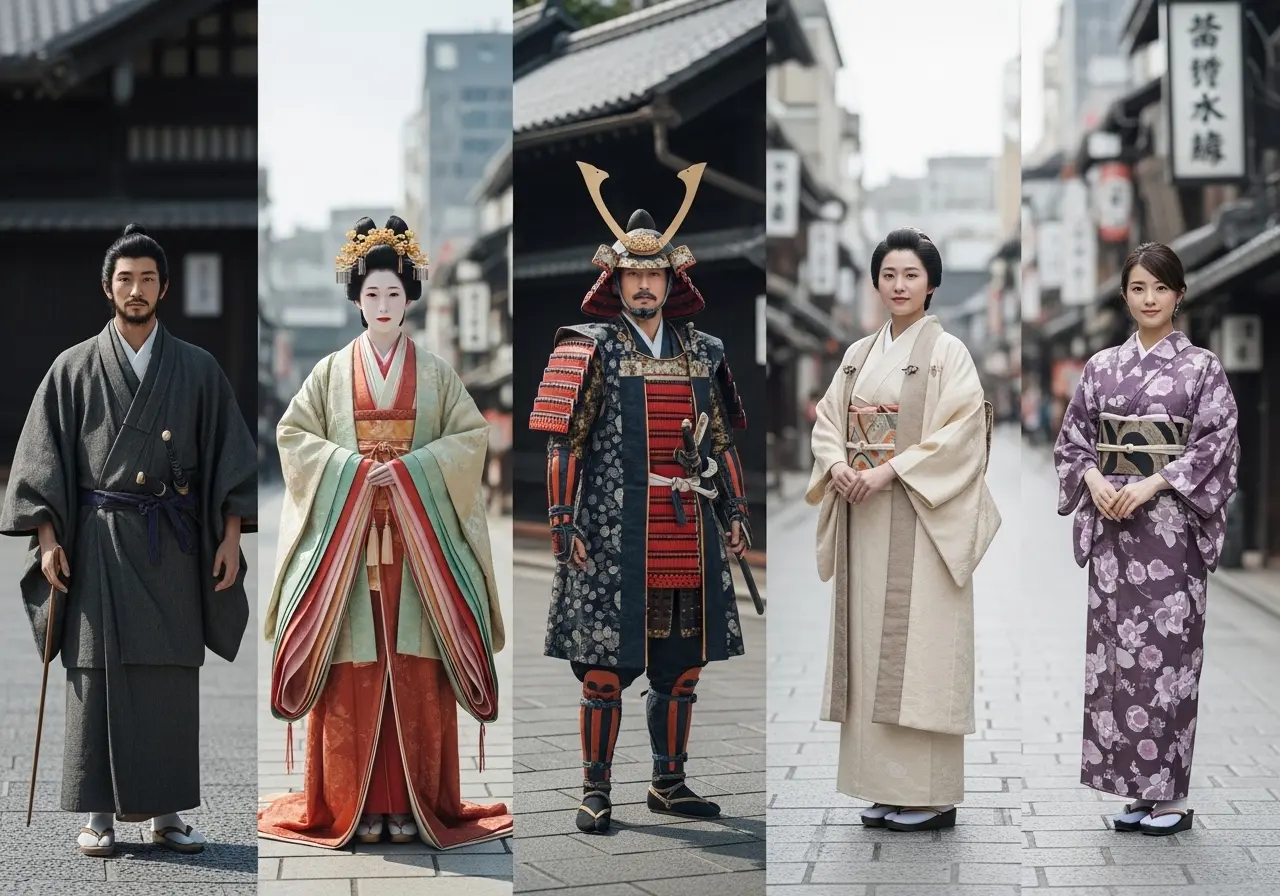
During this era, fashion clearly signaled status. Aristocrats wore wide, flowing sleeves and layered robes, while commoners wore practical tubular sleeves resembling modern shirts.
The foundation of the kimono silhouette we recognize today was formed in this period.
――――――――――
Kamakura period & Muromachi period: Warrior Aesthetics
As the samurai rose to political power, clothing shifted again. Practicality met bold self-expression.
Contrary to modern assumptions, bright colors were not limited to women. Samurai leaders often wore vivid garments and elaborate armor textiles. Clothing became a declaration of strength, identity, and clan pride.
The kimono silhouette grew simpler, yet patterns and dyeing techniques became more expressive.
――――――――――
Edo period: Kimono as Art
The long peace of the Edo period fostered economic growth and artistic refinement. Textile craftsmanship flourished.
Techniques such as intricate dyeing and embroidery transformed kimono into wearable art. The formal “Kamishimo” uniform for samurai became a recognizable symbol of authority.
Because of the skill required to produce these garments, kimono were treasured, passed down through generations, and treated as family heirlooms rather than disposable clothing.
This era firmly established kimono as cultural artistry.
――――――――――
Meiji period to Modern Day: From Daily Wear to Formal Icon
With the Westernization policies of the Meiji era, suits and dresses gradually replaced kimono in daily life. Kimono transitioned from everyday clothing to formal attire known as “Hare-gi.”
Today, kimono are worn for:
Weddings
Tea ceremonies
Coming-of-age celebrations
University graduations (often paired with Hakama)
Although no longer daily wear for most people, the kimono remains deeply embedded in Japan’s cultural identity.
――――――――――
A Living Symbol of Japanese Beauty
From two-piece court garments to layered aristocratic robes, from warrior boldness to Edo artistry, the kimono reflects every major transformation in Japanese history.
It is not merely clothing. It is architecture made of fabric—constructed with straight lines, enriched with color philosophy, and preserved through generations.
When you wear a kimono in Osaka today, you are not just dressing up. You are stepping into over a thousand years of evolving tradition, artistry, and seasonal poetry.






 BOOK NOW