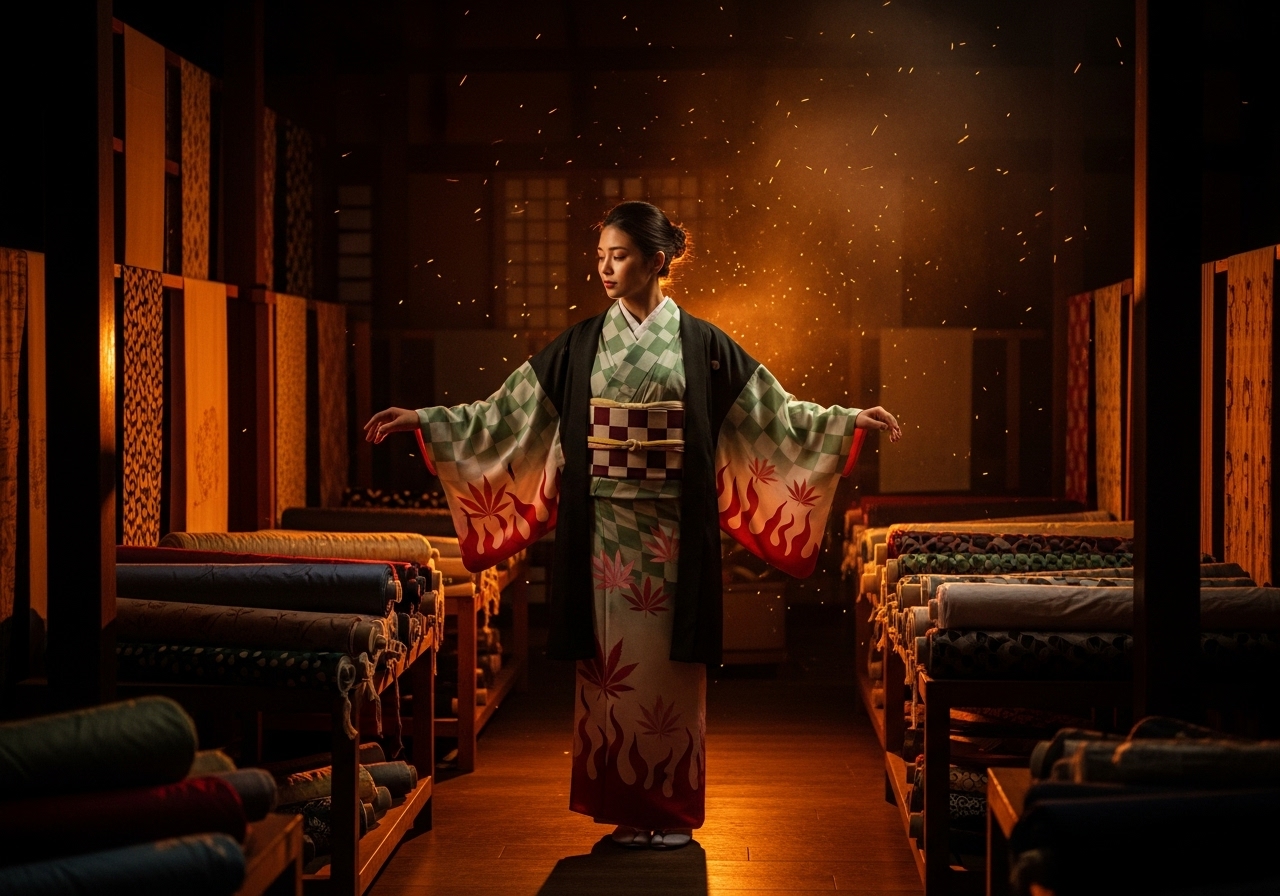
Demon Slayer and the Global Revival of Kimono Culture
When Demon Slayer: Kimetsu no Yaiba first aired in 2019, most people saw it as a breathtaking action anime.
What few realized was that it would ignite something far beyond the screen —
a global revival of Japan’s traditional kimono culture.
From Kyoto’s textile workshops to anime conventions in New York and Paris,
the ripple effect of Demon Slayer has turned a centuries-old garment into a modern icon once again.
???? 1. From Period Drama to Pop Culture Phenomenon
Set during Japan’s Taisho era (1912–1926), Demon Slayer blends historical realism with mythic storytelling.
Every detail — from wooden houses to swordsmith villages — is grounded in Japanese craftsmanship.
But it’s the kimono designs that breathe authenticity into the world.
Each major character wears a distinct haori or kimono patterned with traditional motifs —
not just for aesthetic beauty, but to convey values and emotion.
Tanjiro’s green-and-black checkered ichimatsu design stands for “continuity and perseverance.”
Nezuko’s pink asanoha pattern, shaped like hemp leaves, symbolizes growth and protection.
Rengoku’s blazing flame motif captures moral strength and sacrifice.
These motifs are drawn directly from Edo-period textiles —
and their revival in animation reconnected global viewers with a visual heritage that Japan itself was beginning to forget.
???? 2. A Surge in Kimono Interest and Sales
The cultural impact was immediate.
By 2021, Kyoto-based fabric retailers reported double-digit sales growth in traditional patterns featured in the series.
Online searches for “kimono pattern Demon Slayer” surged more than 700% worldwide,
and Japanese craft markets began selling hand-dyed replicas of Tanjiro’s and Nezuko’s outfits.
In Asakusa and Gion, kimono rental shops started offering “Demon Slayer Style Plans,”
where visitors could rent haori inspired by the show’s characters —
a fusion of tourism, fashion, and pop culture that appealed especially to young travelers.
Even UNESCO cultural programs took note.
Textile artisans in Nishijin (Kyoto) credited the anime with “bringing a lost generation back to kimono appreciation.”
???? 3. The Globalization of a Traditional Art
What’s remarkable is how Demon Slayer transformed the kimono from a symbol of tradition into a global fashion statement.
International designers — from London streetwear brands to Korean couture labels — began referencing its patterns and silhouettes.
In 2022, Paris Fashion Week featured several kimono-inspired coats and layered robes,
with critics describing them as “anime couture.”
The Demon Slayer aesthetic — graphic geometry, dramatic layering, and spiritual symbolism —
fit perfectly into the global appetite for storytelling through fashion.
Brands such as UNIQLO, GU, and Hot Topic released licensed kimono jackets,
bridging the gap between casual wear and cultural tribute.
???? 4. Reviving Traditional Craftsmanship
Beyond fandom, something more profound was happening inside Japan.
Artisans from Kyoto’s Nishijin weaving district and Okinawa’s Bingata dyeing studios reported renewed interest from young apprentices —
a profession once considered to be fading.
Workshops that had been struggling to attract visitors suddenly found queues of students,
inspired by the idea that ancient textile art could live again through modern media.
The Kyoto Prefectural Textile Association even launched an exhibit titled
“Kimono in Anime: From Screen to Silk,”
featuring real garments woven using the same patterns seen in Demon Slayer and Spirited Away.
Attendance exceeded 200,000 visitors — many of them under 30.
???? 5. Symbolism That Transcends Borders
Why does the kimono resonate so deeply across cultures?
Because it represents something universal: identity expressed through craft.
In Demon Slayer, the kimono is not a costume — it’s a soul.
Each color, fold, and fabric layer reflects moral values: compassion, duty, courage, and grief.
For global audiences, these are not “Japanese-only” themes; they are human.
When fans cosplay as Nezuko or Tanjiro, they aren’t just mimicking appearances —
they’re stepping into a moral world where every pattern tells a story.
That emotional connection makes the kimono more than fashion; it becomes a language of empathy.
???? 6. Tourism, Economy, and the “Kimono Renaissance”
Japan’s tourism board quickly noticed the trend.
Between 2022 and 2024, kimono rental shops in Kyoto, Nara, and Kanazawa reported record bookings from overseas visitors.
Many tourists specifically requested “anime-style” kimono —
not as novelty, but as a bridge to cultural immersion.
Travel agencies began curating “Demon Slayer Trails” across Japan:
visiting Mount Kumotori (Tanjiro’s home inspiration),
Tokyo’s Kimetsu Café, and traditional dyeing studios in Kyoto.
The result: a new form of cultural tourism where pop culture leads visitors back to authentic heritage.
Even rural prefectures like Tottori and Yamagata, known for historical weaving,
saw increased local revenue as kimono artisans collaborated with animation studios.
????️ 7. Cultural Preservation Through Pop Culture
Rather than “commercializing” tradition, Demon Slayer reframed it.
It made young people proud of their culture again —
reminding Japan and the world that the kimono can evolve without losing its essence.
“We used to see the kimono as something formal, something distant,”
says Kyoto-based dyer Kazuhiro Yoshida.
“Now, when young people see these designs in anime, they see courage, not constraint.
That gives our craft a future.”
✨ 8. The Future of the Kimono in Global Fashion
As sustainable fashion gains momentum, the kimono — a garment designed to last for decades and be repaired, resized, and reused — is reemerging as an eco-conscious symbol.
Its revival through anime has aligned perfectly with global interest in slow fashion and cultural authenticity.
In 2025, exhibitions in London and Los Angeles titled “Kimono Reimagined”
showcase both historical pieces and modern adaptations inspired by Demon Slayer and other anime.
The message is clear: the kimono isn’t a relic — it’s a revolution.
???? Final Reflection
From the battlefields of Taisho-era fiction to the streets of Shibuya and Paris,
the kimono has reclaimed its voice.
Demon Slayer didn’t just make viewers cry —
it made them care about an ancient craft, about color and pattern as symbols of hope.
In a world obsessed with fast fashion and digital speed, the kimono’s calm precision feels like resistance —
a reminder that true beauty is woven slowly, by hand, through stories worth remembering.
The flame of Rengoku still burns —
not only in hearts, but in threads.






 BOOK NOW